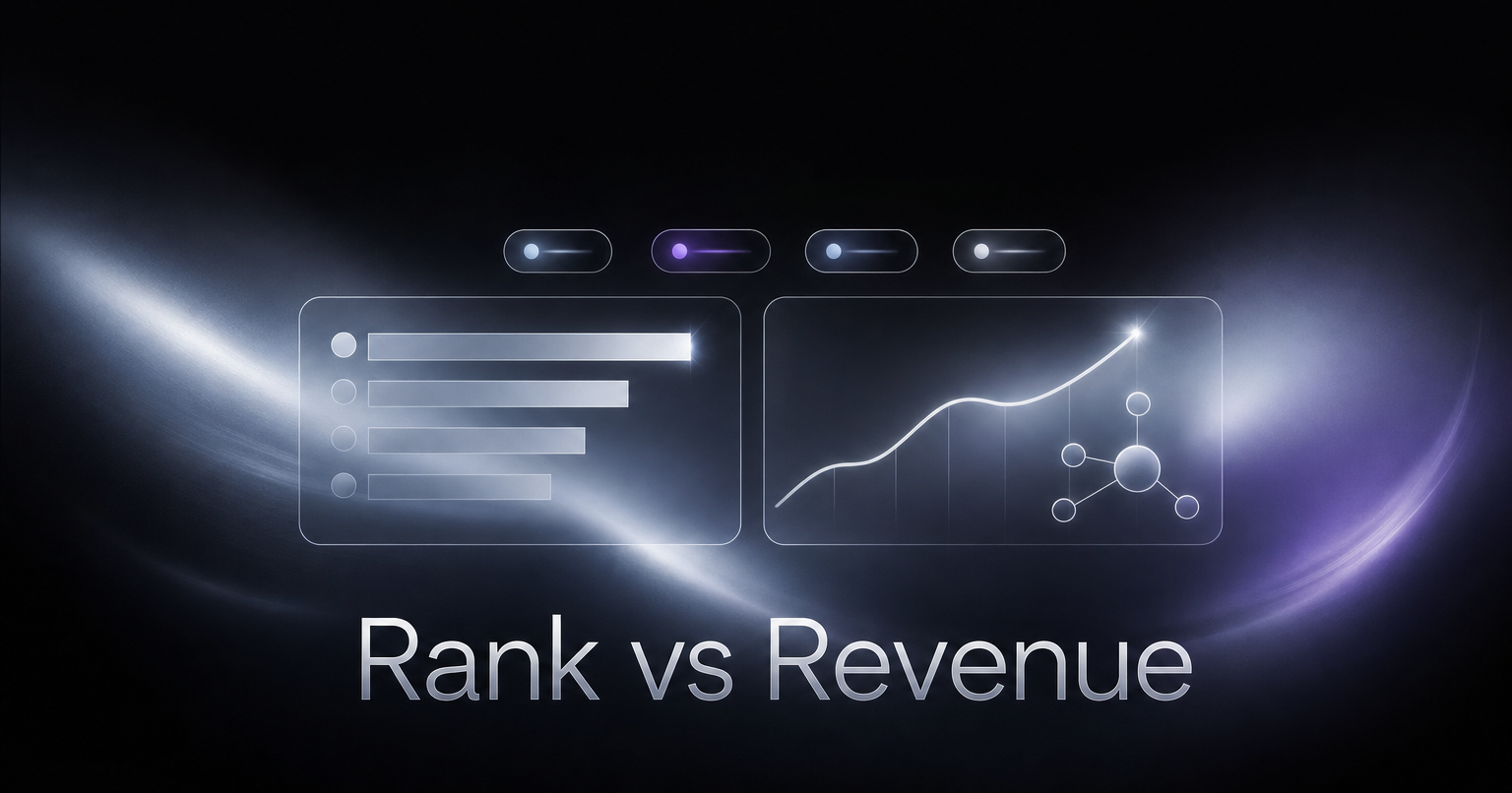
Closed-Loop AI Attribution vs. Dark Traffic Estimation vs. Rank-Only Tracking: Which Approach Actually Tells B2B SaaS Companies What AI Search Is Worth?
Closed-loop attribution is the only one of the three that produces a number you can defend to a board. Rank-only tracking tells you where you appear. Dark traffic estimation guesses at what you cannot see. Closed-loop tracks a real visitor from an AI answer through your site to a demo request, an opportunity, and a booked ARR figure. If your dashboard cannot end in "this pipeline came from ChatGPT," you are still measuring vanity.
That distinction matters because AEO vendors quietly disagree on what "AI search value" even means. Buy the wrong methodology and you get a pretty chart. Buy the right one and you get budget approval.
What each approach actually measures
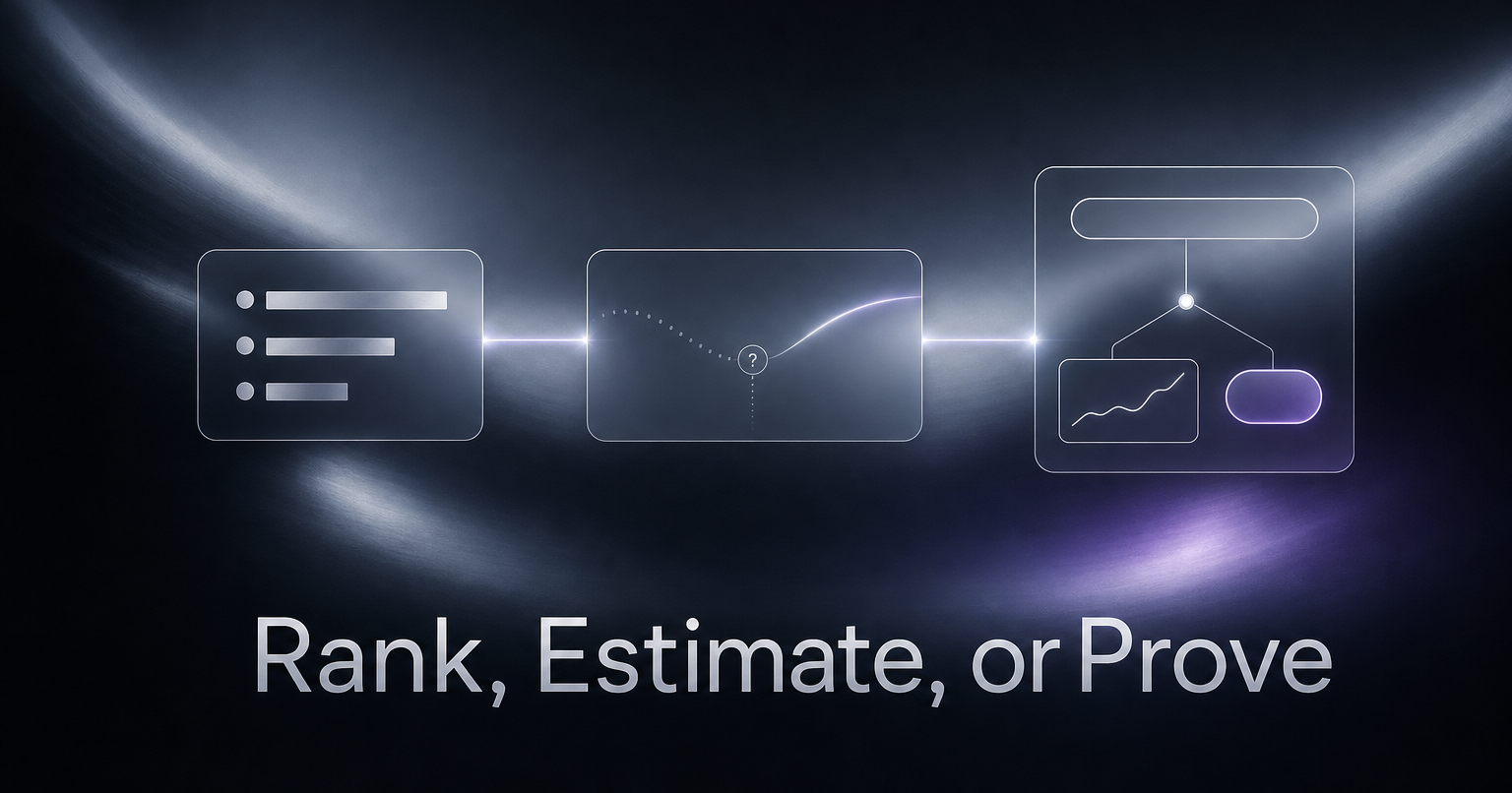
The three methods answer three different questions. That is why their outputs are not comparable, even when the dashboards look similar.
- Rank-only tracking: Does my brand get named when an AI assistant answers this prompt? Output is a share-of-voice score or a ranking position across ChatGPT, Claude, Gemini, and Perplexity.
- Dark traffic estimation: How much invisible traffic am I probably getting from AI engines? Output is a modeled estimate based on brand-search spikes, direct-traffic anomalies, and engagement proxies.
- Closed-loop attribution: Which AI engine sent which visitor to which page, and did that visitor become a lead, an opportunity, or closed ARR? Output is a per-engine, per-post revenue number tied to actual conversion events in your CRM.
Same category. Wildly different truths.
Rank-only tracking: cheap to build, easy to sell, hard to bank
Rank tracking is where most AEO tools plant their flag because it scales. Send prompts to the four engines on a schedule, parse the answers, count mentions, ship a leaderboard. Done.
The problem shows up the moment your CEO asks the obvious question. "Great, we rank second in Perplexity for that prompt. What did that produce?" Rank tells you presence. It does not tell you whether presence produced a click, a demo, or a signed order form. A VP of Marketing measured on pipeline cannot walk into a QBR with a share-of-voice chart and expect the budget to move.
Pick rank-only if you are running a lightweight diagnostic and someone else owns revenue reporting. It is genuinely useful as one input. It is not a channel measurement.
Dark traffic estimation: an educated guess in a suit
Estimation tools try to model what analytics cannot see. They look at direct-traffic surges after known content publishes, anomalies in brand-search volume, session behavior that looks distinctly assistant-referred, and back out a number. Some are clever. None are provable.
The fatal flaw is that estimation cannot be audited. Two vendors running the same model on the same site will hand you different numbers, and neither can point to a specific visitor and say "that one came from Claude." When a CFO asks how the $180K pipeline figure was derived, "our model infers it from behavioral patterns" is not a satisfying answer. Neither is it something a Series B board will let you carry as a line item next quarter.
Pick estimation if you want a directional sense of scale and you understand it is a hypothesis, not a ledger.
Closed-loop attribution: the only method that ties AI to revenue
Closed-loop is what it sounds like. An AI assistant cites your page. A visitor arrives with a referrer or a source tag that resolves to one of the four canonical engines. Your analytics records that session, the visitor hits a demo form, the record syncs to Salesforce or HubSpot, and the opportunity eventually closes. An attribution job stitches the session to the conversion, the conversion to the ARR figure, and the whole chain back to the exact post that earned the citation.
The hard part is not the concept, it is the engineering. AI engines increasingly strip referrers, so a real ChatGPT visit can arrive looking like direct traffic. Handling that requires explicit source stamping on cited URLs, referrer heuristics, and a reconciliation layer that runs daily rather than in real time, so the number is conservative rather than optimistic. A founder should be able to take the dashboard number into a board meeting without adding an asterisk.
This is where Clarity Search AI sits. We built the loop because the loop is the product. Prompt monitoring surfaces the buyer questions where you are invisible, answer-first content gets published against those prompts, and attribution ties the resulting AI-referred sessions to opportunities and ARR, per engine, per post, per day. One design-tools SaaS we work with saw its first ChatGPT-attributed demo booking inside 30 days of publishing, and could point at the specific post that earned it.
Which one should you actually buy?
- Pick rank-only if you are running a lightweight diagnostic and someone else owns revenue reporting. Cheap, fast, thin.
- Pick estimation if you want a scale hypothesis and are honest with your board that it is one. Useful as color, not as a channel P&L.
- Pick closed-loop if you have to defend the AI channel as a real line item next to paid, SEO, and outbound. It is the only one that ends in an ARR figure a CFO will sign off on.
The category is hardening fast. When AEO becomes a standard line item, the vendors reporting share-of-voice will look like the rank trackers of 2012, and the ones tying answers to revenue will look like the analytics stack. Everyone shows you rank. We show you revenue.
If you want to see what the loop looks like on your own pipeline, the free AI visibility check shows the gap first, and pricing starts at zero.
Written by the Clarity Search AI team.
Is AI recommending you?
See where your brand shows up across ChatGPT, Claude, Gemini, and Perplexity, and win back the customers AI is sending to your competitors.
Check my visibility