SEO vs. Answer Engine Optimization: What's Actually Different
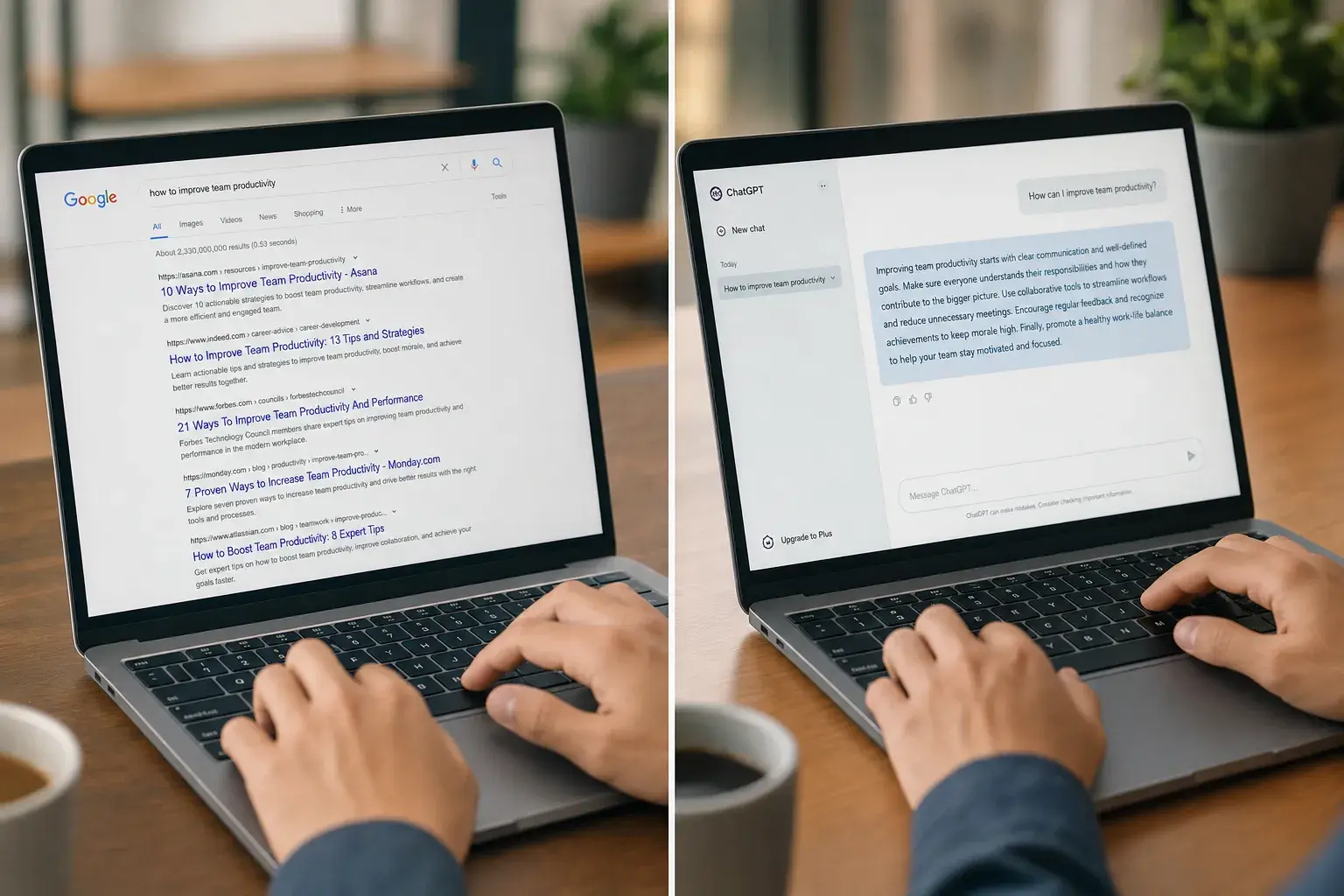
SEO is how you get found in a list of blue links. Answer Engine Optimization (AEO) is how you get named inside the answer itself. SEO competes for clicks on a results page; AEO competes to be the brand ChatGPT, Gemini, Claude, or Perplexity recommends when someone asks "what's the best...". Same goal (visibility), different game.
Here's the part most marketers miss: ranking #1 on Google does not guarantee you'll be mentioned by an AI. The signals overlap, but they are not the same, and the user behavior on the other end of each is fundamentally different.
The short answer
- SEO optimizes your site so a search engine surfaces it in a ranked list of links a user clicks through.
- AEO optimizes your brand, content, and structured data so a large language model includes you in the synthesized answer it gives the user directly.
A Google search returns ten options. ChatGPT returns one or two. AEO is the work of being one of those one or two.
Where they overlap
Strong fundamentals still matter. Clean site architecture, fast pages, real authority signals, accurate business info: AI engines crawl and weight these too. If your SEO house is on fire, your AEO will be too.
Both also reward clarity. A page that answers a specific question well ranks better on Google and gets quoted more often by an LLM. Schema markup, FAQ blocks, and well-structured headings help both.
If you've done the SEO basics, you are not starting from zero. You're starting from maybe 40%.
Where they diverge, criterion by criterion
The output the user sees
SEO produces a SERP: a list. The user picks. Your job is to earn the click.
AEO produces a paragraph: a recommendation. The user often does not click anything. Your job is to be inside the paragraph, by name, with the right context attached.
How ranking works
Google ranks pages using a known (if opaque) mix of links, content quality, behavioral signals, and E-E-A-T. You can A/B test your way forward.
LLMs do not "rank" in the same sense. They've been trained on a corpus, then they retrieve from a more recent index at query time, then they synthesize. Your brand gets pulled in if it appears often enough, in the right contexts, with consistent descriptions, across sources the model trusts. That's a different optimization target.
What you optimize
- SEO: title tags, meta descriptions, internal linking, backlinks, page speed, keyword targeting, content depth.
- AEO: entity consistency across the web, structured FAQs the model can lift verbatim, llms.txt files, schema that defines what your business actually does, third-party mentions in the contexts you want to be recommended in, and (this is the new one) the prompts your customers actually type.
How you measure success
SEO measures rankings, impressions, organic clicks, and conversions from those clicks.
AEO measures mention rate (how often you show up in AI answers), sentiment of those mentions, share of voice against named competitors, and which prompts trigger you versus your rivals. That's the core of what Clarity Search AI's AI Visibility Score tracks: across ChatGPT, Gemini, Claude, and Perplexity, are you in the answer or not?
How fast you can move
SEO compounds slowly. Six to twelve months is normal for a competitive term.
AEO can move faster on the way up, because LLMs re-crawl and re-index more aggressively, but it can also move faster on the way down. A competitor publishing a strong comparison piece can displace you in AI answers within weeks.
Pick SEO if..., pick AEO if...
You don't pick. You do both. But the weighting depends on where your customers actually start.
Lean harder into SEO if your buyers still research through Google, your category is heavy on transactional queries ("buy X near me"), or your traffic is mostly bottom-of-funnel.
Lean harder into AEO if your buyers are asking open-ended questions ("what's the best CRM for a 5-person agency?"), your category is recommendation-driven, or you're seeing organic traffic erode without an obvious SEO reason. That erosion is often AI answers absorbing the click.
What to do this week
Run an honest audit. Ask ChatGPT, Gemini, and Perplexity the questions your customers ask. Note who gets named. If it's not you, that's your gap.
From there, the work is concrete: tighten your entity data, publish FAQ content that answers real prompts in full sentences, and track mention rate over time. The live audit takes about 15 seconds and tells you where you stand. If you'd rather see the workflow first, the product walkthrough shows what AEO looks like in practice.
SEO got you found. AEO gets you recommended. In 2026, you need both.
Written by the Clarity Search AI team.
Is AI recommending you?
See where your brand shows up across ChatGPT, Claude, Gemini, and Perplexity, and win back the customers AI is sending to your competitors.
Check my visibility