Do You Need Separate Tools for AI Visibility, Content, Site Audits, and Attribution?
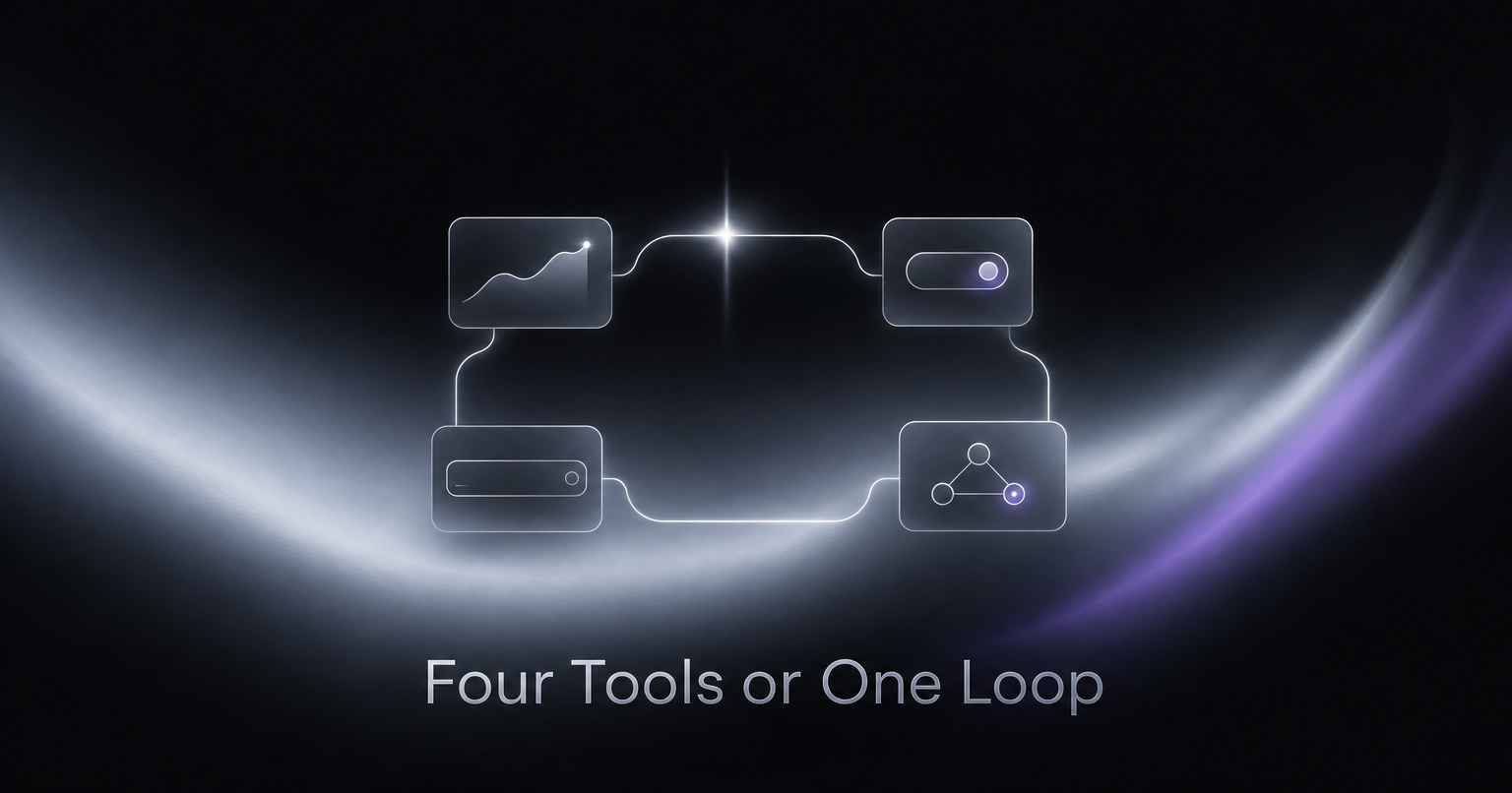
You can run AI visibility monitoring, content, site audits, and attribution as four separate tools, and most teams start that way. What you cannot buy separately is the handoff between them, and the handoffs are where the results come from. A visibility tracker that cannot commission a post. A writer that does not know which questions you lose. An audit tool that never learns which pages earn AI traffic. An analytics setup that files ChatGPT visits under "direct." Four correct products, one broken chain.
So the honest answer is yes, one platform can do all four. Whether you want that comes down to how much manual reconciliation you are willing to do every week.
What does the typical four-tool AEO stack look like?
Most stacks assembled in 2026 follow the same shape:
- An AI visibility tracker. Runs your buyer questions through ChatGPT, Claude, Gemini, and Perplexity and reports mention rate, position, and competitor share of voice.
- An AI writing tool. Turns a topic you hand it into a draft. It has no independent idea what your buyers ask an assistant.
- A technical SEO or audit crawler. Finds broken canonicals, missing structured data, noindex accidents, robots.txt over-blocking. All of which AI crawlers read.
- Your analytics, plus a spreadsheet. Sessions and conversions, minus the referrer data the engines increasingly strip.
Each tool does its job. The monthly bill is rarely what breaks a stack like this, so stop comparing line items and look at the seams.
Where does the stitched stack actually break?
Four places, and every one of them is a seam rather than a feature.
Topic selection runs blind. Your tracker knows you are invisible on "best [category] tool for [use case]." Your writer does not, because nothing carries that finding across. A human reads the leaderboard, picks a topic, pastes a prompt. That step gets skipped in week three.
Nothing re-measures the question you wrote for. Publishing a post against a gap is half an experiment. Unless something keeps putting that same question to the engines after the post goes live, you never learn whether the answer moved. Separate tools share no memory of which question a post was aimed at.
Attribution has a hole in it. Analytics shows sessions and revenue, but AI referrers arrive stripped or disguised, and no analytics tool will tie a closed deal back to the specific post that earned the citation. We covered the mechanics of that gap in closed-loop attribution versus dark-traffic estimation versus rank-only tracking.
The audit never gets prioritized by evidence. A crawler lists 200 issues by severity. It has no idea which of your pages are already pulling AI traffic, so the fix that matters most sits at number 47.
Every one of those seams gets patched by the same person: usually the founder, or a new head of growth under pressure to prove a channel in 90 days.
What does one platform do differently?
Clarity runs all four as one agent. Clark has exactly four jobs, Blog Creator, Lead Attribution, Site Audit, and Prompt Monitoring, each set up and managed independently. The difference is what passes between them.
Monitoring feeds the writer, but only on evidence. Clark does not rewrite your content plan because one answer came back badly. Before a monitored question counts as content-gap evidence, it needs a 45-day window behind it, at least two distinct analysis dates, and six usable answers. Until that history exists, the question-finder mines the live web for how people actually phrase the question: search phrasings, people-also-ask style queries, forum threads.
The loop runs the other direction too. Pages already earning AI traffic in the last seven days get fed back into the finder, so proven winners get deepened instead of abandoned. And Clark will not re-answer a question it already covered. The finder receives the exact questions answered in the last 30 days as an avoid list, and it has to clear a lexical similarity check against recent posts before it commits, so a reworded repeat gets caught rather than published.
Site Audit sits in the same loop instead of off to the side. One run combines a Lighthouse-grade audit on up to 5 pages, a technical crawl of up to 50 pages running 17 checks, and a click-gap analysis of pages that rank but do not get clicked. The crawl is the part that finds real problems: canonical conflicts, accidental noindex, invalid JSON-LD, missing structured data, orphan pages, robots.txt over-blocking. Every issue carries a fixability rating, and that includes the honest category. Some issues Clark fixes itself as a pull request. Some need a human decision. Some are hosting or infrastructure problems no code change can solve, and those carry no fix button at all.
Attribution closes the circuit. Coverage is your whole site, not only Clark's posts, so any landing page taking AI traffic is tracked and the pages Clark wrote are tagged in the ranking. If your site fires a purchase event, you see measured revenue. If you track leads but not sales, you see Potential Revenue, your AI-attributed leads multiplied by the per-lead value you set. We call that a projection because that is what it is. Nothing gets written back into your analytics either; the picture lives in Clarity.
That is the loop. Not a feature list. It is the reason the four jobs live under one agent.
Pick separate tools if, pick one platform if
Pick separate tools if you already have a content team producing work you are proud of and only need measurement, if procurement has you locked into multi-year contracts, or if the capability you need most sits outside what any consolidated platform covers, off-site placement and review-site PR being the usual example.
Pick one platform if you are a small B2B SaaS with no content or SEO team on staff and nobody has three hours a week to reconcile three dashboards. That is the case where fragmentation does not really cost you money. It costs you a quarter.
The cheapest way to find out which side you are on is to look at your own gap first. Run a free AI visibility check, see which competitors get named on your buyers' questions, and decide from there. That is one snapshot, and Clark runs it continuously, but the snapshot alone usually settles the argument. Start free and scale when it proves it.
Written by the Clarity Search AI team.
Is AI recommending you?
See where your brand shows up across ChatGPT, Claude, Gemini, and Perplexity, and win back the customers AI is sending to your competitors.
Check my visibility