How AI Agents Actually Decide Which Business to Recommend
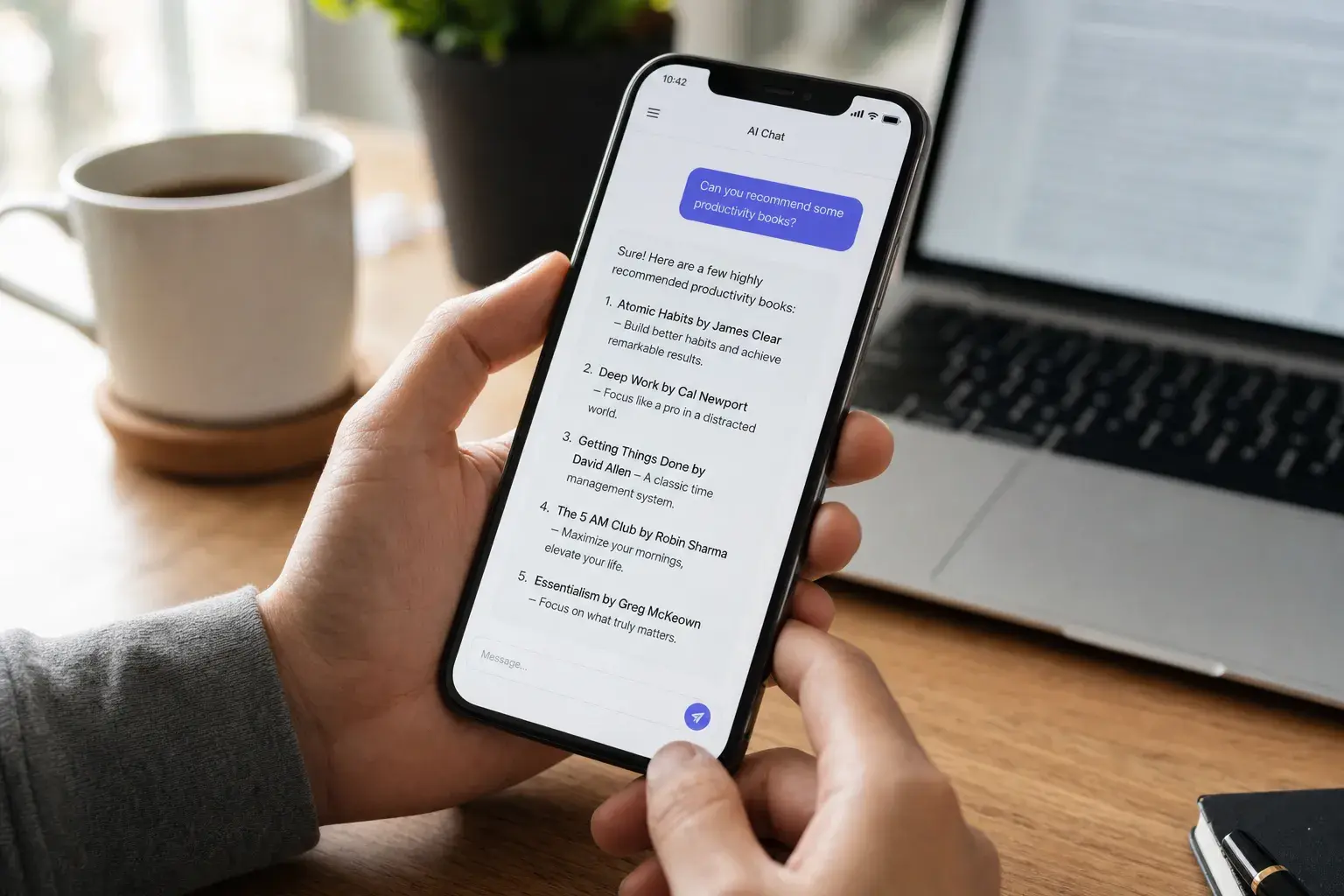
When someone asks ChatGPT "what's the best CRM for a two-person law firm?" or tells Perplexity "find me a sustainable coffee roaster that ships to Oregon," the model returns a short, confident list. It usually names three to five businesses. It does not show 10 blue links. It does not say "here are 4.2 million results."
So how does it pick?
The honest answer: AI agents are not running a single ranking algorithm the way Google does. They are stitching together four different signals, in real time, and the business that wins is the one that shows up cleanly across all four. Below is what those signals actually are, why each one matters, and where most small businesses lose the recommendation before they even know they were in the running.
1. Training data: what the model already "knows" about you
Every large language model has a memory of the web from its last training cut. If your business was mentioned in articles, forums, review sites, podcast transcripts, GitHub READMEs, or Reddit threads before that cutoff, the model has some baseline familiarity with your name, what you sell, and what people said about you.
This is where authority signals do their heavy lifting. Not backlinks in the SEO sense, but distributed mentions: a Hacker News comment recommending you, a roundup on a niche blog, a Substack writer naming you in an aside. The model averages all of that into a fuzzy reputation vector. A business that has been organically discussed in 40 different contexts will beat a business that has only ever appeared on its own homepage, even if the homepage is better written.
The practical implication: getting mentioned, accurately and in context, on third-party sites matters more than getting linked.
2. Real-time retrieval: what the model can fetch right now
ChatGPT with browsing, Perplexity, Gemini, and Claude all reach out to the live web when a query needs current information. This is where retrieval-augmented generation (RAG) takes over. The agent issues its own search queries, pulls a handful of pages, and reads them before composing an answer.
Two things determine whether your page gets pulled:
- Crawlability for AI user agents. GPTBot, PerplexityBot, ClaudeBot, and Google-Extended each have their own crawler. If your robots.txt blocks them, or your content lives behind heavy JavaScript that the crawler will not execute, you are invisible at the retrieval step.
- Semantic match to the actual query. The agent is not searching for keywords; it is searching for passages that answer the user's intent. A page titled "Our Services" loses to a page titled "Best CRM for solo law practices under $50/month" every time, because the second one matches the query's literal shape.
3. Content structure: can the model extract a clean answer?
Once a page is fetched, the model parses it and looks for liftable statements. This is the part most businesses get wrong. A paragraph that buries the answer in marketing language ("we pride ourselves on delivering exceptional...") is useless to an agent. A sentence that says "Acme CRM costs $29/month, supports up to 3 users, and integrates with Gmail and Outlook" is gold, because the model can quote it directly.
Structured data helps here too. Schema markup, FAQ blocks, and clear H2 questions give the model unambiguous handles. The Clarity Search AI product page walks through the specific schemas and FAQ patterns that improve extraction rates, and the underlying logic is simple: write the way the model needs to read.
4. Intent matching and trust filtering
The final layer is the model's own judgment about whether recommending you is appropriate for the user's specific situation. A query like "affordable plumber near me in Raleigh" filters out national chains. "Enterprise data warehouse for a Fortune 500" filters out two-person shops. The agent reads cues in the user's wording (budget, location, scale, industry) and matches them against what your content says about your customer fit.
If your site never names your customer (small businesses? agencies? enterprises?), never names your price range, and never names your geography, you get filtered out of half the queries you should win. Regional pages like the ones for North Carolina, Texas, or California exist for exactly this reason: they give the model the geographic and contextual anchors it needs to recommend a local business confidently.
What this means for your next move
You cannot game an AI agent the way some marketers gamed early SEO. The four signals above reinforce each other, and weakness in one drags down the others. A site with perfect schema but no third-party mentions will get retrieved and then passed over. A business with great press but a slow, JS-heavy site will be remembered vaguely and never quoted.
The work is to be legible in all four layers at once: discussed elsewhere, crawlable here, structured for extraction, and explicit about who you serve. Run an audit against your top 10 buyer questions and see which layer you are losing on. That is the work that moves the recommendation.
Written by the Clarity Search AI team.
Is AI recommending you?
See where your brand shows up across ChatGPT, Claude, Gemini, and Perplexity, and win back the customers AI is sending to your competitors.
Check my visibility