How to Tell If an AI Agent Prefers Your Competitor Over You
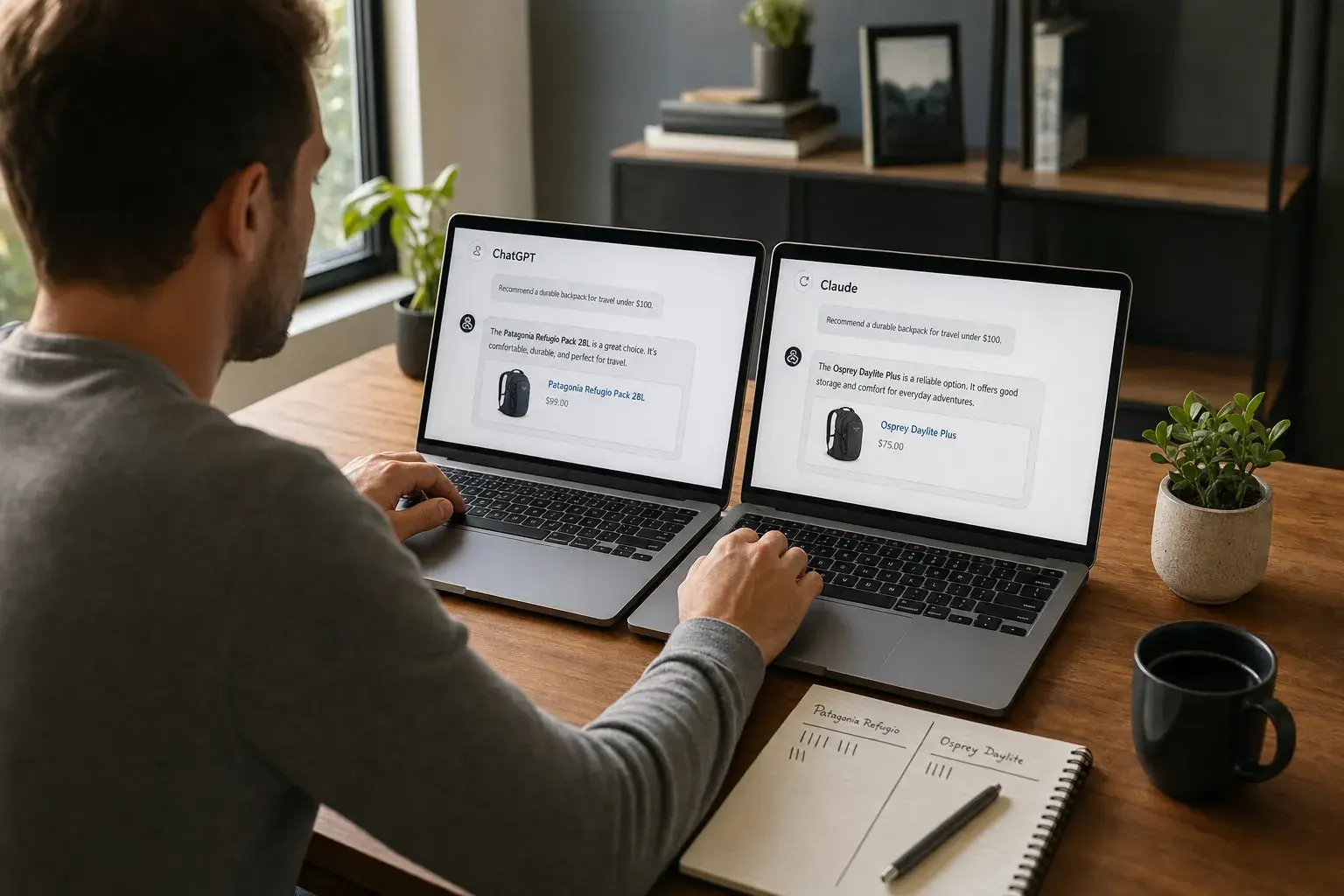
If ChatGPT, Gemini, Claude, or Perplexity keeps recommending the shop down the street instead of yours, you will not get a polite email about it. The signal is silent. To know whether an AI agent prefers a competitor, you have to test the same prompts a real buyer would type, count who gets named, in what position, with what framing, and how often it repeats across models and sessions. That is the entire job. Everything below is how to do it well.
Step 1: Build the prompt set a real buyer would actually use
Start with the questions a customer asks before they buy, not branded queries. "Best ergonomic office chair under $400," "top CRM for a 5-person agency in Austin," "who makes the most durable hiking boots for wide feet." Aim for 15 to 30 prompts that cover comparison, location, use case, price band, and "best for [persona]" variants.
Skip prompts that include your brand name. Those tell you nothing about competitive preference, only about brand recall once a user already knows you exist.
Step 2: Run each prompt across every major model
ChatGPT, Gemini, Claude, and Perplexity do not agree with each other. A competitor can be invisible on one and dominant on another. Run every prompt across all four. Open a fresh session for each (no memory, no prior context) so personalization does not bias the result.
Record three things per response:
- Who is named: every brand the model mentions, in order.
- How they are framed: "top pick," "popular alternative," "budget option," "best for beginners."
- What evidence the model cites: review sites, the brand's own pages, Reddit threads, news coverage.
That third field is the one most people skip, and it is the one that explains why the AI picked who it picked.
Step 3: Score the gap with three concrete metrics
Forget vague impressions. Use numbers you can track week over week.
- Mention rate: out of N prompts, how often does your brand appear at all? If your top competitor lands in 22 of 30 responses and you land in 4, that is your gap.
- Position rank: when you are mentioned, are you first, third, or buried in a list of nine? First and second mentions carry the recommendation weight; everything after is filler.
- Sentiment and framing: "trusted leader" and "newer entrant worth considering" both count as mentions, but they sell very differently.
Clarity Search AI's AI Visibility Score rolls these into a single number you can watch over time, but you can also run a manual version in a spreadsheet for a weekend audit.
Step 4: Reverse-engineer why the AI prefers them
Once you know which competitor is winning, open the sources the model cited and look for patterns. Almost every time, one or more of these is true about the competitor:
- They have a clean, schema-marked FAQ that answers the buyer's exact question.
- They show up in third-party "best of" lists from sites the AI trusts.
- Their product pages use plain-language headings that match how people ask, not internal jargon.
- They have an llms.txt or structured data that gives crawlers a tidy summary.
- Their Reddit and review presence is active, with specific use-case language.
If a competitor wins on three of those and you win on zero, the AI is not being unfair. It is doing exactly what it was built to do.
Step 5: Re-test on a schedule, not a whim
AI model updates can shuffle rankings overnight. Run the same prompt set monthly at minimum, weekly if you are in a fast-moving category. The point is the delta, not the snapshot. A competitor pulling ahead two months in a row is a trend; one bad week is noise.
What to do with what you learn
Once you can see the gap clearly, the work gets focused: write the FAQ the competitor wrote and you did not, get listed where they got listed, fix the schema, clean up the product page language. If you would rather not run the audit by hand across four models every month, that is what tools like Clarity Search AI are built for, including the free visibility report if you just want to see where you stand today.
The brands that win in AI recommendations are not the loudest. They are the ones that measured, found the gap, and closed it before the competition noticed.
Written by the Clarity Search AI team.
Is AI recommending you?
See where your brand shows up across ChatGPT, Claude, Gemini, and Perplexity, and win back the customers AI is sending to your competitors.
Check my visibility