What is the AEO content flywheel, and how does it compound AI citations into growth for B2B SaaS?
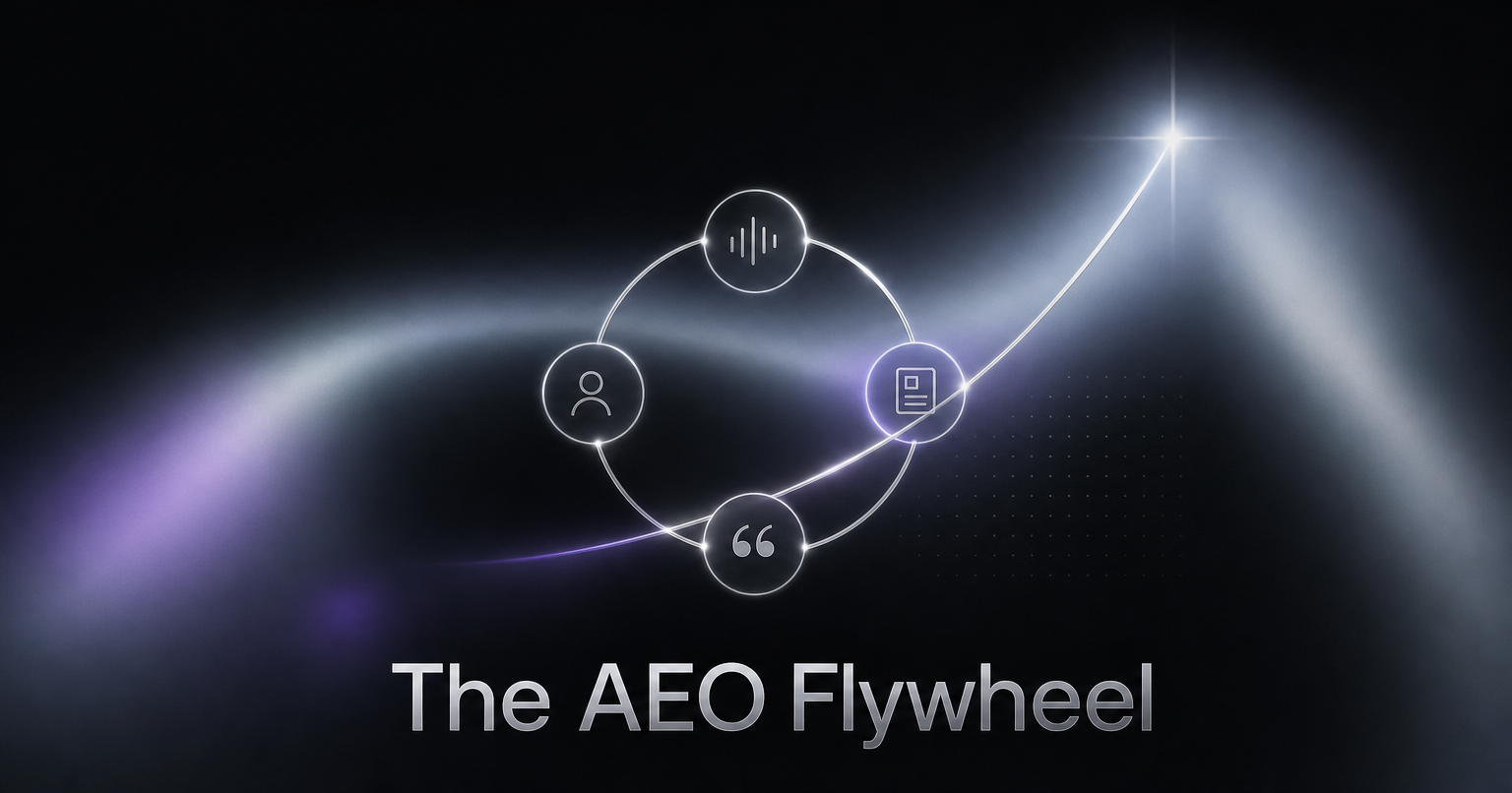
The AEO content flywheel is a self-reinforcing loop where real buyer questions asked to AI assistants become the fuel for new blog posts, those posts earn citations from ChatGPT, Claude, Gemini, and Perplexity, and the citations lift your topical authority so the next round of questions surfaces you more often. Each turn of the loop makes the next turn easier. Unlike an SEO strategy that waits two quarters to move, an AEO flywheel can shift share of voice inside four engines within weeks.
That is the short version. Here is what a founder or a new Head of Growth actually needs to hold in their head.
What powers the loop
Answer engines do not rank a page the way Google does. They pull passages that cleanly answer a question, weight them by how often a source gets cited and how confidently it answers, and stitch a response. That mechanic rewards a different behavior than classic SEO. Precision beats breadth. Answer-readiness beats keyword density. One well-targeted post can get quoted across all four engines the same week.
Two properties make it a flywheel and not a checklist:
- Feedback is measurable. You can watch, daily, which prompts name you and which name your competitors. That data is not a lagging indicator. It is the input to the next post.
- Authority compounds inside a category. Once you are the source an engine reaches for on "best onboarding tool for early-stage SaaS," being reached for on the adjacent question gets cheaper. Topical clusters lift each other.
The four moving parts of the loop
Think of the flywheel as four stages, each of which produces the input for the next.
Prompt monitoring. You ask the exact questions your buyers ask, verbatim, across ChatGPT, Claude, Gemini, and Perplexity, every day. You record who gets named. The prompts where you are invisible are not a problem list. They are the content backlog, ranked by real demand.
Content aimed at the gap. A post is written to answer that specific question, answer-first, grounded in your own material and voice. No throat-clearing intro. A definition an engine can quote without stitching. Question-shaped headings that mirror how a buyer phrases things to an assistant.
Citation earned. The engines start pulling that passage. You show up in answers where you did not before, in some cases inside a week. That is the moment where AEO diverges from SEO's slow burn.
Attribution and reinforcement. The AI-referred visit lands, converts, and you can tie the dollar back to the specific engine and the specific post that earned the citation. Now you know two things: which posts pay, and which topical territory to expand into next. That answer feeds monitoring again, which reprioritizes the backlog.
The reason this compounds, rather than just cycles, is that stage four sharpens stage one. You are not writing more content. You are writing better-aimed content, informed by which prompts moved and which conversions closed.
Why the flywheel matters more than any single tactic
A rank tracker tells you where you stand. A content AI writes posts. Analytics counts sessions. Bought separately, they do not talk. A founder or a lone growth hire ends up hand-reconciling three dashboards and guessing at the connections. That is not a flywheel. That is a to-do list.
Citations also concentrate. Categories with three to five well-cited brands harden. The engines lean on sources they have already validated, so early movers become the default authority and the cost of dislodging them climbs. If 71 percent of B2B buyers now use AI chatbots to research vendors, the window where a category is still cheap to enter is the window that matters.
A working example: a funded B2B SaaS we tracked went from unmentioned in its category to a ChatGPT-attributed sale in under 30 days after running the loop end to end. Tight category, targeted prompts, visible compounding once the first citations landed.
Where to start
If this is your first exposure to AEO, run a baseline. Ask the questions your buyers actually ask across the four engines and see where you get named and where a competitor does. That is stage one of the loop and it is diagnostic on its own. If you want a structured version of the same exercise, the free AI visibility check will show you where you stand today.
Clarity Search AI is built around this exact flywheel. Monitoring finds the gap. Clark writes the post. Attribution proves which citation earned the dollar. It is one loop, not three dashboards.
Everyone shows you rank. The flywheel shows you revenue, and keeps tightening until the next post writes itself out of your own data.
Written by the Clarity Search AI team.
Is AI recommending you?
See where your brand shows up across ChatGPT, Claude, Gemini, and Perplexity, and win back the customers AI is sending to your competitors.
Check my visibility