How to Verify That Schema Markup Is Actually Helping Your AI Visibility

You verify schema markup is helping AI visibility by establishing a baseline of how AI models describe your business before deployment, shipping schema in isolation (no other changes), then re-running the same prompts across ChatGPT, Gemini, Perplexity, and Claude on a fixed cadence and watching for three specific shifts: factual accuracy of returned details, frequency of brand mentions on category prompts, and the appearance of structured attributes (price, hours, service area, ratings) in the model's answer. If those move and nothing else changed on the site, schema is doing work. If they do not move within 30 days, your schema is either invisible to crawlers, contradicted by your visible page content, or pointed at the wrong entity.
Here is the sequence I use when a client ships fresh JSON-LD and wants proof it earned its keep.
Step 1: Lock down a baseline before you touch anything
Before you publish a single line of schema, write down exactly what the major AI models say about your business today. Open ChatGPT, Gemini, Perplexity, and Claude. Ask each one the same five prompts: one branded ("What does [Your Business] do?"), two category ("Best [your category] for [your customer]"), one comparison ("[Your Business] vs [Competitor]"), and one buying-intent ("Where should I buy [your product] online?").
Save the full responses with timestamps. This is your control. Without it, every later "I think it's working" is just vibes.
Step 2: Ship schema as a clean experiment
The single biggest reason teams cannot tell if schema worked is that they shipped schema, rewrote the homepage, added a pricing page, and got three press mentions in the same sprint. Then the AI answer changed and nobody knows why.
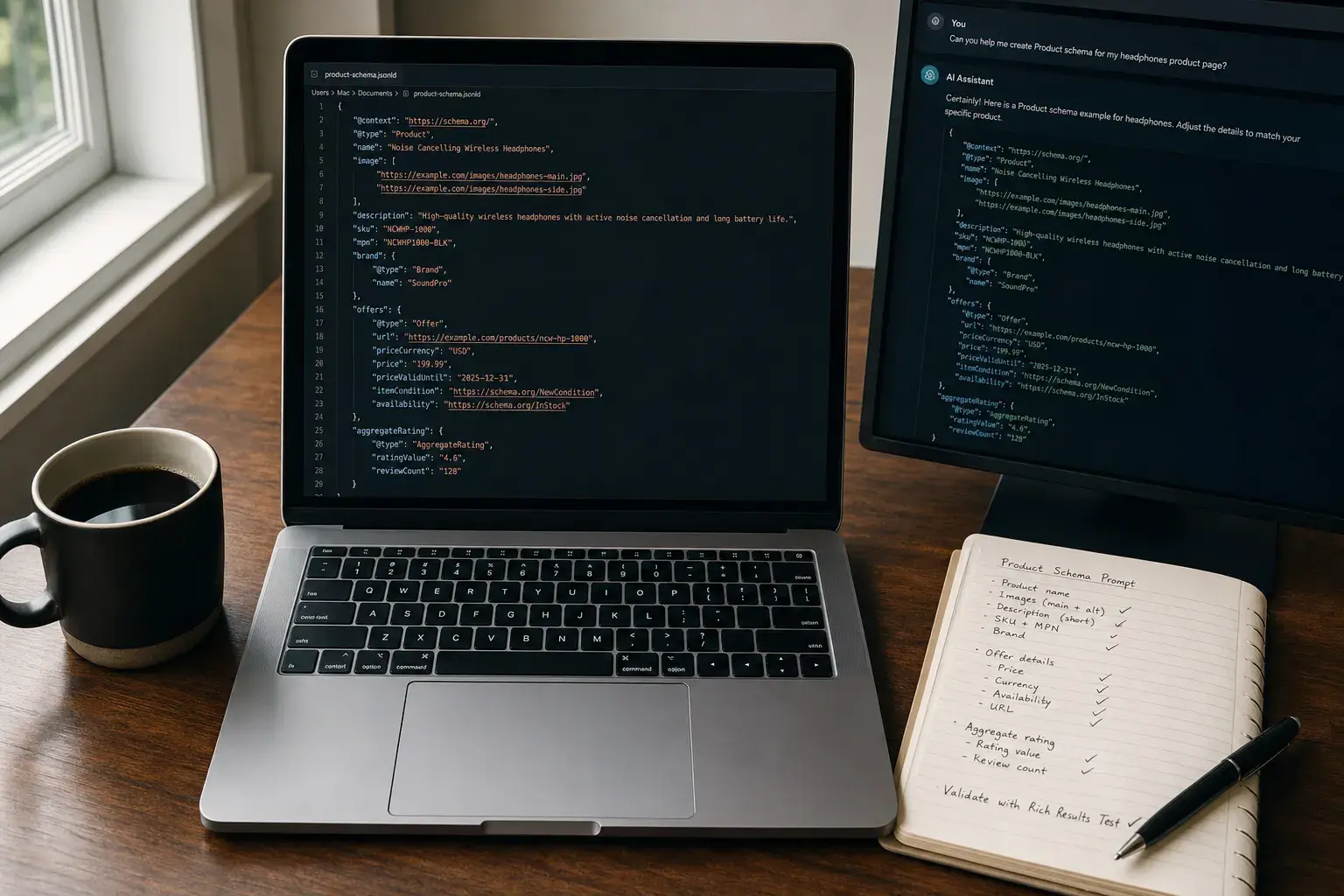
Treat schema like a controlled change. Deploy Organization, Product, FAQ, LocalBusiness, or Service schema (whichever fits) and freeze the rest of the site for at least three weeks. Validate the JSON-LD in Google's Rich Results Test and Schema.org's validator before you call it shipped. Invalid schema is invisible schema.
Step 3: Re-run the exact same prompts on a fixed schedule
Re-query the same five prompts at day 7, day 14, and day 30. Same wording. Same models. New chat sessions every time, with memory off, so the model is not just repeating what you told it last week.
Look for four signals:
- Factual accuracy: Does the model now state your correct founding year, location, product names, and price range? Schema feeds these structured facts directly into model training and retrieval.
- Attribute pickup: Are price, hours, service area, return policy, or aggregate ratings showing up in answers when they were absent before? That is schema getting parsed.
- Mention frequency: On category prompts, how often does your brand appear in the top three to five recommendations? Track it as a ratio across runs.
- Citation hygiene: Is the model linking to your real domain or a third party page about you? Schema strengthens the entity binding between your name and your site.
Step 4: Cross check with crawler and log evidence
Schema only helps if AI crawlers actually fetched it. Check your server logs for hits from GPTBot, ClaudeBot, PerplexityBot, Google-Extended, and Bingbot in the days after deployment. No fetches, no impact. If they are not crawling, your robots.txt, CDN rules, or render path (client-side rendered JSON-LD often fails) is the problem, not your markup.
Step 5: Hold the experiment honest
If your answers improve, great, but ask: did a competitor go dark, did a major review site update, did you get press? Note confounders in your log. The cleanest proof is when schema is the only variable and the same prompt produces a measurably better answer across at least two models.
What "working" actually looks like
A solid schema win, measured cleanly, usually looks like this within 30 days: factual errors drop to zero on the branded prompt, two or three structured attributes (price, location, category) appear in category answers, and brand mention frequency on category prompts rises from roughly zero to two or three in five. That is the realistic ceiling for schema alone. Bigger jumps usually require fixing the other signals AI agents weigh alongside it.
If you would rather not run this manually across four models every week, that before and after measurement is what Clarity Search AI was built for, alongside the broader AEO playbook for AI agents so the rest of your signals are not guesswork. Either way, the rule holds: do not ship schema and hope. Baseline it, isolate it, re-test it, and let the prompts tell you the truth.
Written by the Clarity Search AI team.
Is AI recommending you?
See where your brand shows up across ChatGPT, Claude, Gemini, and Perplexity, and win back the customers AI is sending to your competitors.
Check my visibility